Surface Topography Challenge > Ongoing Work > Newsletter for August 2026
Which optical technique should I use?
[Surface-Topography Challenge August Update]
TABLE OF CONTENTS
A new STC Use Case: Which optical technique should I use?
Featured Paper: Topographic temperature—A description of run-in
STC at WTC: We’re presenting YOUR work at the World Tribology Congress in Brazil!
First, a new STC Use Case: Which optical technique should I use?
[Image credit: Simeona Hein, University of Pittsburgh, 2026]
TITLE: Comparing Optical Profilometer Measurement Modes.
CONTRIBUTOR: Simeona Hein, Graduate Student at the University of Pittsburgh
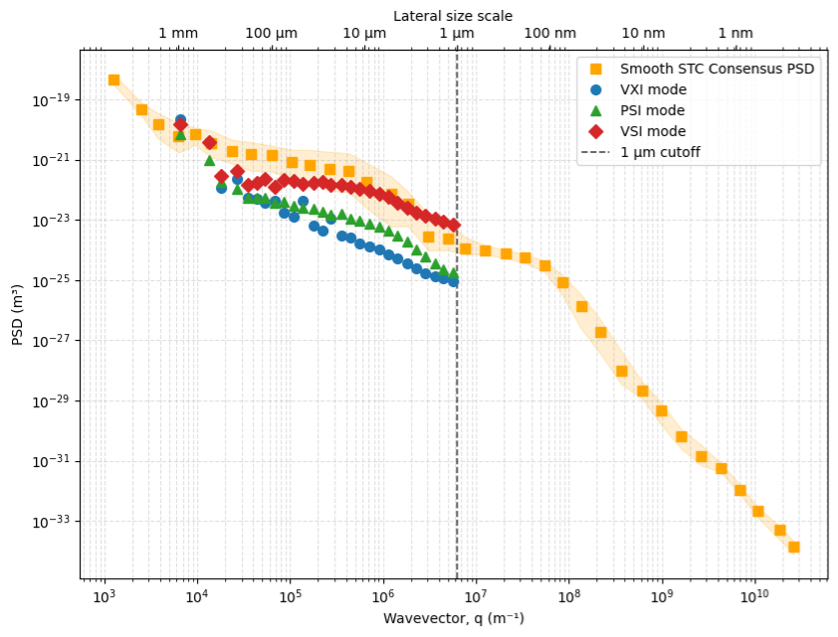
DESCRIPTION: I was interested in evaluating the various measurement modes on our white-light optical profilometer. Specifically, after using the STC samples to verify my training on a stylus profilometer, I began seeing differences across modes the various modes: phase-shifting interferometry (PSI), vertical scanning interferometry (VSI), or a combination technique called “VXI”. We wanted to know which mode was giving us the most accurate measurement, so I decided to use the smooth STC surface and its published consensus data as a reference.
OVERALL PROCESS: I measured the smooth STC surface using all three modes: (PSI, VSI, VXI), keeping constant the other factors like tool, sample, location, and magnification. I uploaded the data to contact.engineering, where I downloaded the average PSD for each dataset. I then compared the three PSDs to the STC results, specifically the published consensus PSD and its variability. Because each mode was measuring the same reference surface, this gave us a straightforward way to evaluate how the choice of measurement mode affected our results.
DETAILS: I used the same standard operating procedure (SOP), which I described in Use Case 1.
RESULT: As shown in the figure, there were discrepancies between the various modes when applied to this STC Smooth sample. It appears that VSI mode showed the best overall agreement with the STC consensus data, while PSI and VXI showed greater deviation, especially at the smaller length scales. This suggested VSI as our preferred mode for measuring samples similar to these, but it also showed us that selecting the best-performing mode was only part of the solution. There was still some deviation between the VSI measurement and the consensus data, reinforcing the STC recommendation to combine measurements from multiple techniques for reliable surface characterization.
(Do you have a way that you’ve used the STC sample/data? Contact us to have it featured!)
Second, this month’s featured Paper: Topographic temperature—A maximum-entropy state description of running-in surfaces
[Image credit: Brodmann and Eifler,Surf. Topog. Met. Props, 2026]
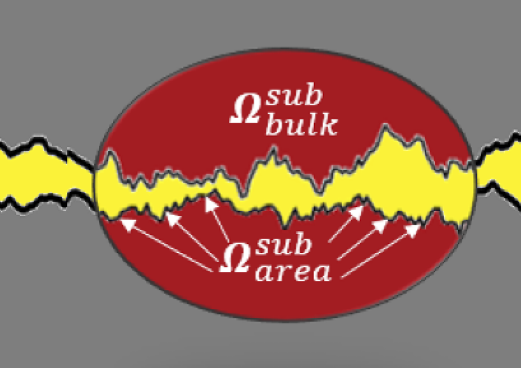
Boris Brodmann and Matthias Eifler suggest an interesting recasting of surface topography as a phase-space representation of coupled height and directional-gradient coordinates, and they derive a maximum-entropy "topographic temperature" that recovers Persson's contact theory in the Gaussian limit.
They use the STC as evidence that the mean surface slopes can be challenging to measure accurately, and to show that scale-aware topography-analysis approaches will be required to validate and use advanced frameworks like this one.
(Do you have a paper that cited the STC challenge? Contact us to have it featured!)
Third, STC at WTC: We’re presenting YOUR work at the World Tribology Congress in Brazil!
Tevis will be presenting a Keynote at the World Tribology Congress in Rio de Janeiro on the Surface Topography Challenge. First, we will cover both the original investigation—which features the measurements from this community, the more than 150 authors of the original paper. Second, we will cover updates since the original paper was published—which covers your Featured Papers, Use Cases, and feedback we’ve gotten from the community. If you’re attending WTC2026, please join us!