Surface Topography Challenge > Ongoing Work > Newsletter for July 2026
How accurate are your topography measurements?
[Surface-Topography Challenge July Update]
TABLE OF CONTENTS
STC Use Case: How accurate are your topography measurements?
Featured Paper: Combining measurements using Bayesian optimization
STC Poster: We presented the attached poster to the Tribology Community!
First, STC Use Case: How accurate are your topography measurements?
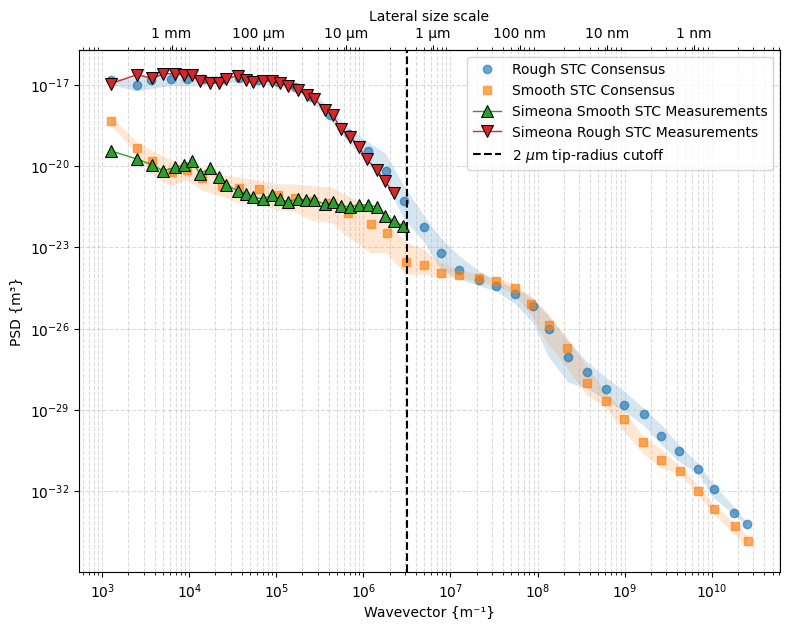
[Image credit: Simeona Hein, University of Pittsburgh, 2026]
TITLE: Verifying Successful Training on an Instrument.
DESCRIPTION: My name is Simeona Hein and I’m a graduate student in materials science & engineering at the University of Pittsburgh. One of the first ways I used the Surface Topography Challenge (STC) samples was to verify my training on a surface-measurement tool. Specifically, I was a new grad student and got trained on a stylus profilometer. I knew that the tool was good, but I wanted to prove to myself and my advisor that I had been trained well and could produce accurate results. So I decided to measure the Surface-Topography Challenge surfaces and compare my measurements against the consensus results.
OVERALL PROCESS: The process was simple: measure the STC surfaces, upload the data to contact.engineering, and compare the resulting power spectral density (PSD) to the published consensus data. Because the consensus PSD represents measurements collected by many researchers using different instruments, it provided a useful benchmark for evaluating my own results.
DETAILS: Here is a standard operating procedure (SOP) describing specifically how I performed the analysis.
RESULT: As shown in the figure, my data (green and red) aligned very well with the consensus data (blue and orange). Good agreement with the consensus data gave me confidence that both my measurement procedure and analysis workflow were working as intended before moving on to unknown samples.
(Do you have a way that you’ve used the STC sample/data? Contact us to have it featured!)
Second, this month’s featured Paper: Combining measurements using Bayesian optimization
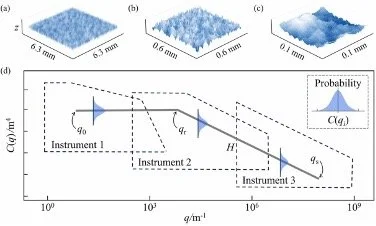
[Image credit: Wang, et al., Tribology International, 2026]
Sihe Wang and coworkers used Bayesian regression to fuse surface topography from three optical instruments into a single continuous PSD spanning six orders of magnitude—with frequency-dependent confidence intervals that quantify the uncertainty that traditional spectral stitching ignores.
They lean on the STC for inspiration, citing it as proof that single-instrument measurements are hostage to their own resolution limits and artifacts. Their multi-instrument, uncertainty-aware method seems like one (of many!) constructive suggestions to divergence that the STC exposed.
(Do you have a paper that cited the STC challenge? Contact us to have it featured!)
Third, a poster on continuing the Surface-Topography Challenge
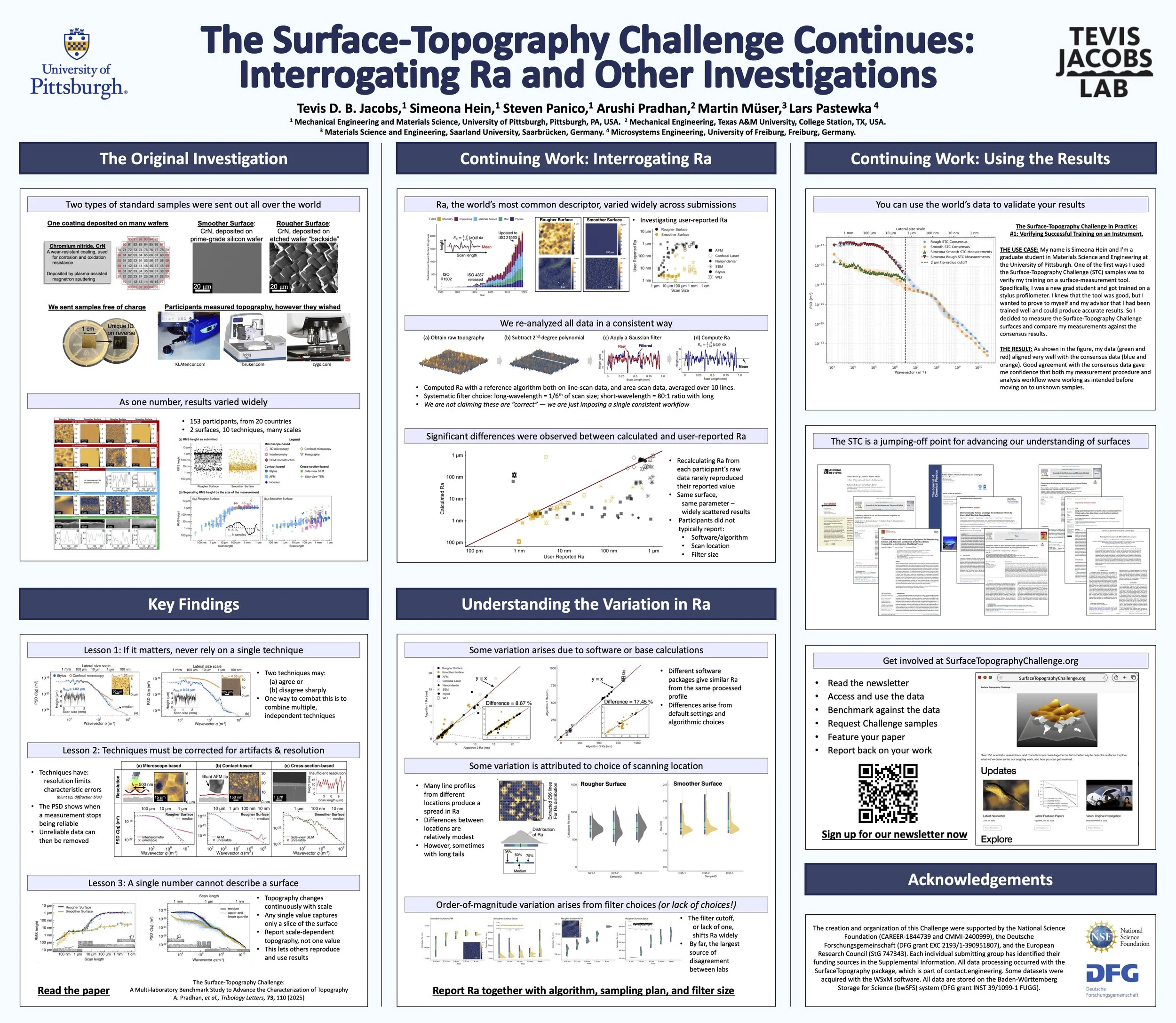
[Image credit: Jacobs, et al., GRC Tribology, 2026]
We presented a poster at the Gordon Research Conference on Tribology about how the Surface-Topography Challenge can continue to benefit the surface-focused community. The poster is attached. Check it out! (Click the image for the full PDF.)